
Most of the people who come to me have already professionally outgrown the way others see them. Behind them are complex projects, results, connections and a reputation, yet from the outside it all still looks like a set of job titles, scattered topics and random publications. In a personal conversation, the link between such a person’s experience, results and professional logic becomes clear fairly quickly. Beyond personal contact, however, it often stays hidden. People usually try to close this gap with promotion: posting more often on social media, building a new website, buying ads. But if the audience does not understand who you are, what place you hold in your professional field and what problem to come to you with, extra visibility only makes that lack of clarity more noticeable.
A personal brand is not there to make a person famous. It is there so that the market’s assessment of their scale does not lag behind the real one. Polina Bondareva
Brand building and public communications expert
Why the market does not see professional scale
Experience is accumulated substance. A brand is the system that makes this substance recognizable, provable and in demand.
Two people may have spent the same number of years in a profession, hold comparable credentials and have a similar set of skills. Yet one will be seen as a strong specialist without a clear focus, while the other comes to mind the moment a specific task appears. This difference is not always about qualifications. What matters a great deal is whether the audience has clear answers to four questions:
- who this person is;
- what their particular value is;
- which tasks they are worth bringing in for;
- which results and facts give grounds to trust them.
As long as the answers exist only in the person’s own head, they are not a market asset. Professional experience becomes capital when its value is clear to others: they can explain what the person is strong at and think of them when a suitable task comes up.
For a company, this function is performed by its brand. For a person, its practical equivalent is reputational capital — accumulated trust, a clear role, lasting associations and evidence that open access to projects, appointments, partnerships, audiences, media and better terms of cooperation.
It is not an accounting figure, and it cannot be valued the way a company’s trademark is. But the economic mechanism is the same: an invisible asset affects whether you make it onto the shortlist, how much effort it takes to vet you and on what terms people are willing to work with you.
What company data shows
One of the best-known arguments for investing in a brand is the performance of the BrandZ portfolio. From April 2006 to April 2017, the value of the BrandZ portfolio of strong brands grew by 124.9%. Over the same period the S&P 500 rose by 82.1% and the MSCI World by 34.9%. In other words, a notional 100 units would have turned into roughly 225, 182 and 135 units respectively.1
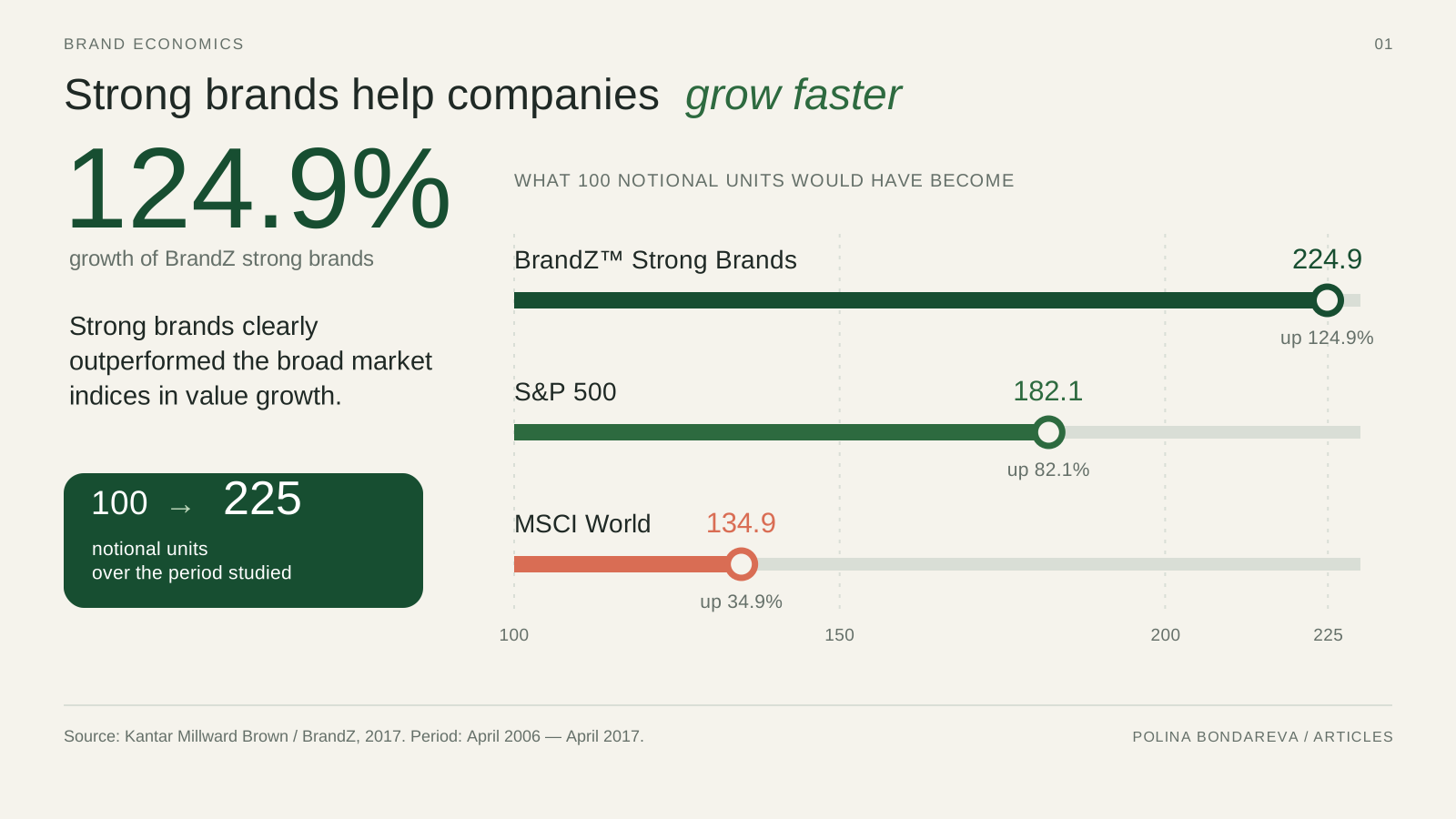
This chart cannot be taken as proof of a direct causal link: working on a brand does not in itself make a company more profitable. The portfolio of strong brands includes strong businesses with products in demand, well-developed distribution, technology and good management. But a brand helps these assets realize their potential: it supports recognition and trust, helps hold prices, strengthens demand and makes it easier to enter new categories.
In their 2017 report, WPP and Kantar Millward Brown specifically noted that the BrandZ methodology combines the perceptions of millions of consumers with companies’ financial and operating data. In this model, then, a brand is not a logo or advertising awareness, but the contribution of the audience’s perceptions to a business’s ability to create future value.
Another important indicator is the share of brand value in market capitalization. An analysis by Type 2 Consulting, based on the Brand Finance, Eurobrand, Interbrand and Millward Brown rankings for 2010–2014, showed large differences between industries: in some of the sampled categories, brand value accounted for roughly 15 to 44% of market capitalization. In a later review within the same research tradition, Jonathan Knowles estimated the average brand share at about 20% of companies’ market value, stressing the wide spread between industries.2
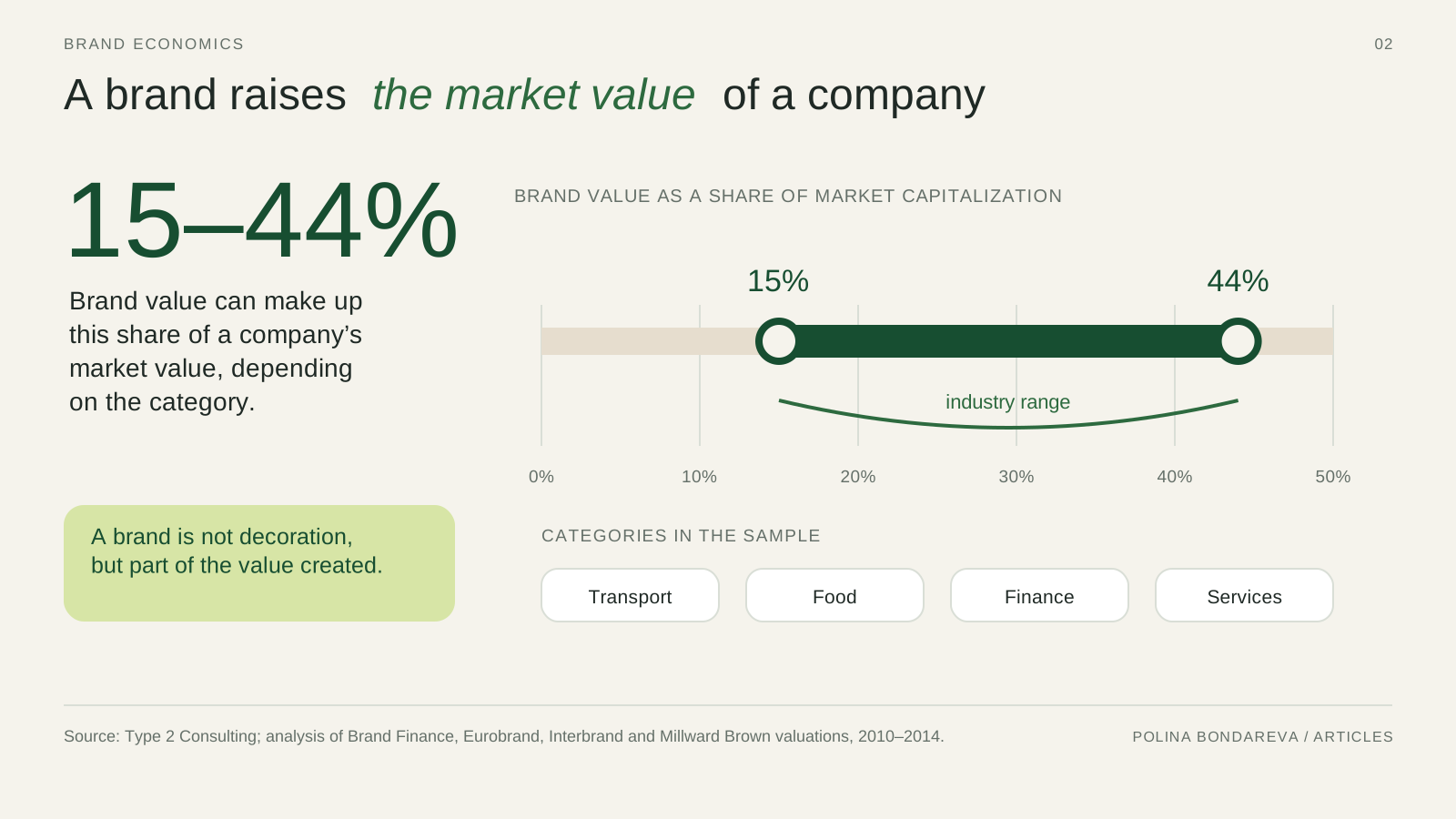
These figures cannot be transferred directly to a person to claim that their name makes up a certain share of their professional value. But when people choose a specialist or a partner, they look at more than the results of their work. It matters how clear the person’s role is, whether consistent quality can be relied on, what risks come with working together and whether there are grounds to trust them. A personal brand helps form this picture before any work together begins.
How you are assessed before a personal meeting
The first decision about a person is often made before anyone talks to them. Their name is searched online, their bio, publications and talks are studied, mutual acquaintances are asked. At this point nobody reconstructs a candidate’s entire twenty-year career. Usually three things need to be understood quickly: what they do now, which tasks they are suited to and what confirms their professional level.
If the bio, public materials and recommendations add up to a clear picture, the introduction does not have to start with explaining every career turn. Even before the meeting, the other side understands which topics the person is associated with, what they have already done and why their experience may be useful in a specific situation.
This is especially important where several people make the decision. A candidate for an executive, adviser, partner or speaker role has not only to be proposed, but also explained to colleagues. The easier it is to state precisely who this person is, what their expertise is and why they are worth considering, the more likely their candidacy is to reach a substantive discussion.
This pattern is clearly visible in research on corporate brands, although its results cannot be transferred directly to people. In 2013, Millward Brown studied the buying habits of 1,600 consumers towards 65 brands in four categories. The purchase volume index was 2.2 for brands with high Brand Power, 0.68 for medium and 0.44 for low. The differences are 3.2-fold and fivefold respectively. This does not mean that brand work guarantees a fivefold increase in sales. The study shows something else: brands with stronger positions win a larger share of consumer choice.3
Kantar comes to similar conclusions. According to the company, brands with high Demand Power get nine times the volume share, those with high Pricing Power get twice the consumer spend, and brands with high Future Power are four times more likely to grow their value share than those with low scores.4
For an individual specialist, the equivalent of market share is a place on the initial shortlist. People think of them when a suitable project appears, recommend them without long explanations and screen them out less often before the first meeting. This does not yet guarantee being chosen, but it creates the chance to move on to a conversation in which experience and qualifications can be assessed on their merits.
A clear brand lowers the cost of a decision
Daniel Kahneman described two systems of thinking. The first works fast and relies on familiar images and associations. The second comes in when information is insufficient, contradictory or needs analysis. The model does not apply directly to personal brands, but it helps explain why, with comparable qualifications, the advantage often goes to the person whose professional role is clearer.
If a bio, publications and talks do not add up to a coherent picture, a potential client or partner has to work it out alone: how the different stages of a career connect, what the specialist’s method is, how they differ from their peers and whether their past experience applies to the new task. Such analysis takes time and attention. In practice, a candidacy may be put off or left off the initial shortlist altogether — not for lack of competence, but because its value could not be assessed quickly.
A clear brand does not replace checking qualifications, but it sets the starting frame for it. The bio, cases, publications and talks consistently show the field a person works in, the tasks they solve, how they approach their work and the results that confirm it. The other side no longer has to connect scattered facts on its own.
That is why recognition in itself has little effect on choice. You can appear often in the media and on social networks without creating a lasting professional association. The task of a strategy is to determine not only where and how a person should be visible, but also which task should make people think of them.
Why words about values alone are not enough
Brand platforms often list values as general words: “growth”, “honesty”, “professionalism”, “benefit to people”. On their own, such words say little about a person. Values gain meaning when they help understand which tasks a person chooses, which principles they stand up for, which compromises they will not make and which projects they may turn down.
The link between a stated position and real actions also shapes attitudes to companies. In 2018, Unilever reported that its 28 Sustainable Living Brands were growing 69% faster than the rest of the corporation’s brands. These are the internal figures of a single company, so they do not prove that having a mission in itself ensures growth. What matters is something else: Unilever linked the result to brands whose sustainability principles were built into their products, innovation and operations, rather than remaining part of an advertising campaign.5
Research on consumer behavior shows a similar dependency. In a 2017 Cone Communications survey, 87% of American respondents said they would buy a product from a company that supports an issue they care about, and 76% said they might refuse to buy if a company’s position contradicted their beliefs.6
A global Havas study in 2021, with 395,000 participants, recorded both high demand and low trust at the same time. 73% of respondents expected brands to act in the interests of society and the planet, yet 71% doubted that companies would keep their promises. In respondents’ view, 75% of brands could disappear without any significant consequences for their lives.7
These results cannot be transferred directly to a personal brand: the studies are about companies and consumer choice. But similar logic applies to a specialist, executive or entrepreneur. The louder the principles are declared, the more closely the audience compares them with decisions and actions. A gap between words and deeds becomes a reputational risk.
In a personal brand, values are not needed for a separate section of a website. They help to:
- explain the logic of your professional decisions and refusals;
- make your position consistent and recognizable;
- define the circle of people and organizations with whom long-term cooperation is possible.
A value becomes part of a position only if real decisions stand behind it. If a declared principle affects nothing and does not limit any choice, for the audience it remains a general statement.
When a specialist stops being compared on price alone
In the same Millward Brown study, the index of the price actually paid was 1.06 for strong brands, 1.00 for medium and 0.93 for weak ones. The gap between the extreme groups reached 13 index points.3
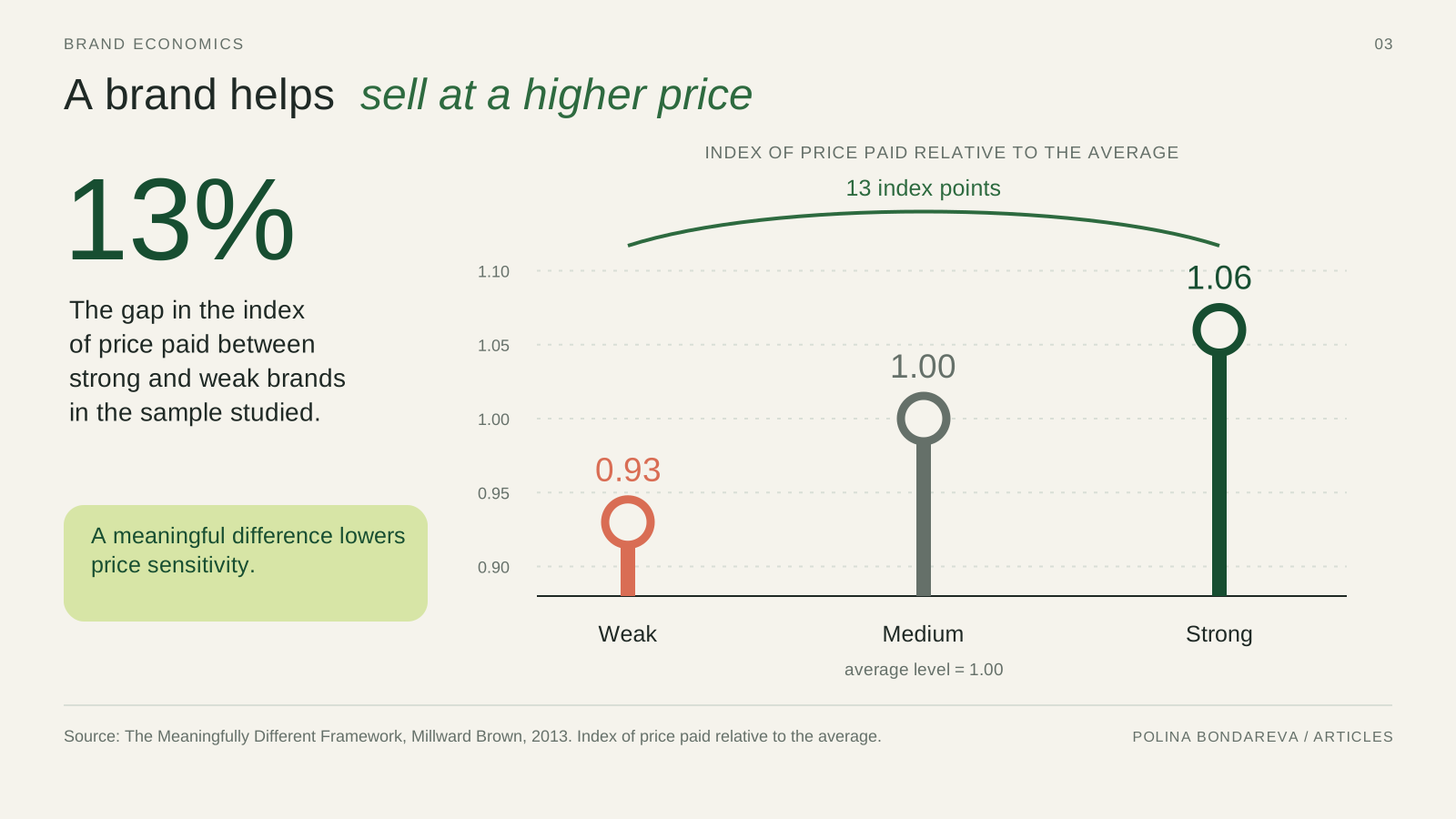
These figures cannot be transferred directly to the price of a specific person’s work, for example by promising a 13% higher fee after brand work. The price of services depends on how rare the skills are, the complexity of the task, proven results, the market situation and negotiating skill. But a brand affects the criteria a client uses to compare candidates.
When no meaningful differences are visible, the choice has to be made on the most accessible parameters: price, deadlines, years of experience or the job title on a CV. Once it is clear exactly how a specialist differs and which tasks they are particularly strong at, the client starts to weigh other factors too: the likelihood of a mistake, how precise the proposed approach is, how predictable the result is, trust and the possible consequences of a poor choice.
That is why the economic effect of a personal brand is not limited to higher fees. It can show up as:
- better terms of cooperation;
- access to larger and more complex projects;
- the freedom to choose topics, teams and partners;
- less dependence on discounts;
- less time spent getting a candidacy approved;
- more incoming offers.
A clear brand does not cancel the conversation about price, but it changes what that conversation is about. Instead of asking “why does this specialist cost more”, the client starts to assess which risks their involvement reduces, which problem they can solve and what a less precise choice would cost. Price remains a condition of the deal, but stops being the only clear basis for a decision.
Why rare expertise is not enough for a lasting advantage
It may seem that a person with a rare technology, unique expertise or high administrative status does not need a brand. Sometimes that is true. While specialists are few and demand exceeds supply, the client chooses above all access to scarce expertise.
But even in a narrow category there are almost always alternatives. A railway may hold a monopoly on rail transport, yet in the market for getting from A to B it competes with airlines, buses and cars. In the same way, a specialist is compared not only with members of the same profession. Instead of hiring them, a company may bring in a consultancy, build an in-house team, turn to an industry institute, roll out a digital platform or hand part of the task to an AI service.
Over time, an advantage based on a new product or method also fades. Successful solutions get copied, technologies become more accessible, and rare skills are gradually mastered by other market players. What set one specialist apart yesterday may become a standard requirement of the profession tomorrow. After that, the choice is decided not only by a set of skills, but also by results, reputation, trust and how easily the specialist can be fitted into a specific task.
A single tool, phrase or topic is relatively easy to copy. It is much harder to reproduce a coherent professional system that has grown out of a person’s experience and has been proven in practice:
- your own view of a professional problem;
- an original methodology and working models;
- a clear language and system of terms;
- a body of evidence and recognizable cases;
- products, a community, media and partner relationships;
- consistency of decisions and public behavior.
As soon as the audience stops seeing a meaningful difference between a specialist and their alternatives, the comparison returns to the simplest parameters: price, deadlines and availability. The task of positioning is not to declare a person unique, but to show in which tasks their combination of experience, approach and results creates an advantage.
A lasting position is not formed by a skill that no one has managed to copy yet. It emerges when experience, method, evidence and reputation add up to a system that is hard for competitors to reproduce, but easy for a client to understand and explain.
Promotion converts current demand. A brand shapes future demand
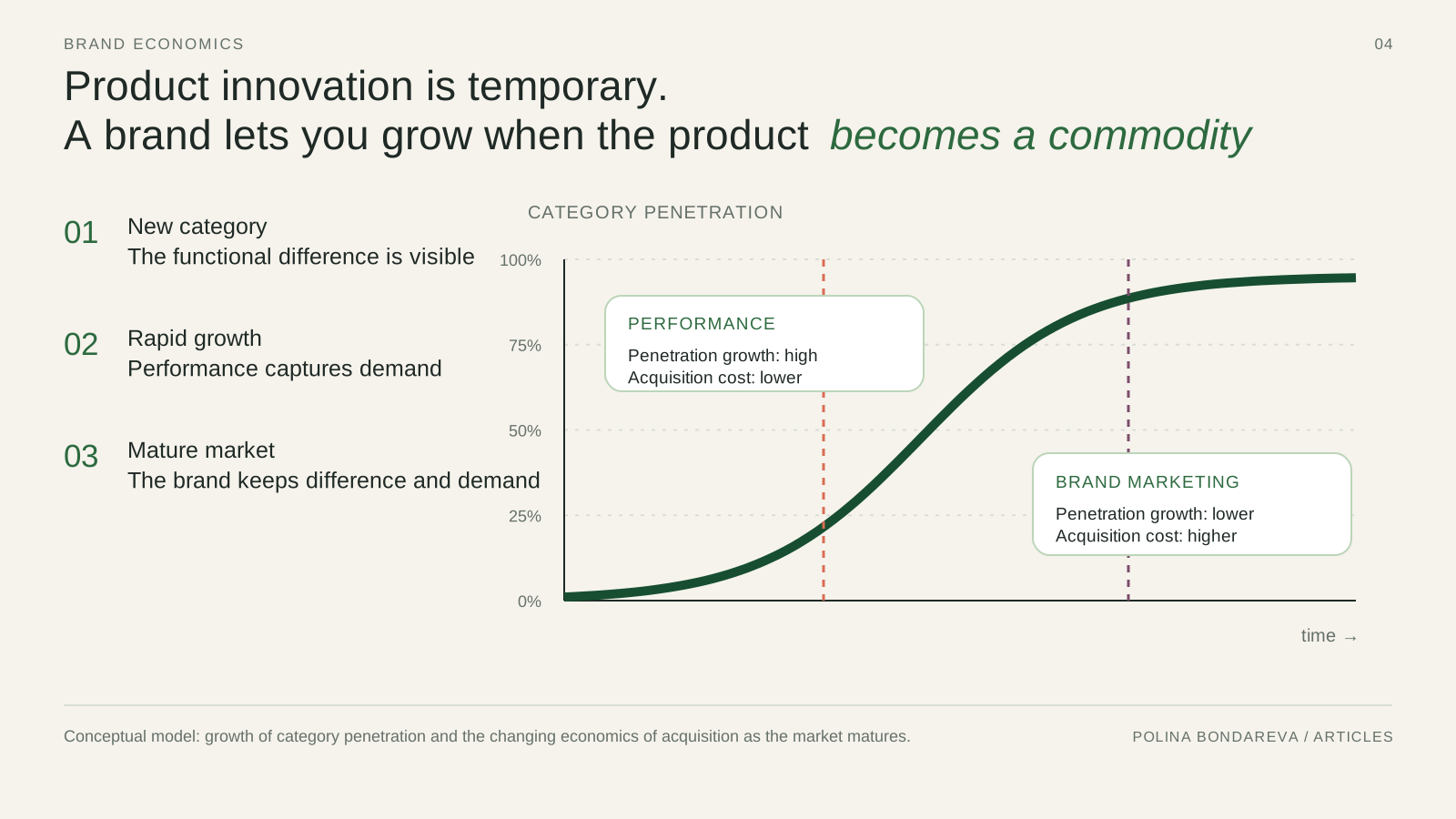
The debate about which matters more — the brand or performance marketing — rests on the wrong question. These tools solve different problems and work over different time horizons.
Performance communications help turn interest that has already arisen into a specific action: an inquiry, a subscription, a meeting or a purchase. A brand starts working earlier — when there is no immediate need yet. It builds awareness, trust and a lasting association, so that when a task comes up, a person or company is quicker to make the list of options being considered.
Over time, activation alone is no longer enough. Ad auctions get more expensive, the same audiences burn out, and every next contact has to be paid for again. If there is no clear brand behind the promotion, the result depends too heavily on the advertising budget: as soon as the activity stops, the flow of inquiries shrinks along with it. Accumulated brand awareness reduces this dependence, because part of the audience already knows the offer and comes through searches for the name, recommendations or direct requests.
A telling corporate example is Airbnb. From 2019 the company began shifting its marketing spend towards the brand and reducing its dependence on search advertising. In 2022 The Wall Street Journal wrote that Airbnb had stuck with this approach and reported its most profitable quarter to date. Its marketing spend as a share of revenue was low enough that the company did not plan to cut it drastically even if the economy worsened.8
A single case does not allow us to claim that cutting a performance budget automatically raises profitability. Airbnb’s financial result was influenced at the same time by the recovery of the travel market, changes in demand and operational decisions. Still, the example shows the model a business with a strong brand aims for: not to buy every contact anew, but to gradually increase the share of people who come directly, already knowing the company and understanding its offer.
Research by Les Binet and Peter Field, based on IPA effectiveness cases, produced a well-known benchmark: put 60% of marketing investment into long-term brand building and 40% into short-term activation. But this is not a universal budget formula. The right balance depends on the category, the brand’s stage of development, the sales model, the competitive situation and the length of the deal cycle. What matters is not the ratio itself, but the need to create future demand and convert existing demand at the same time.9
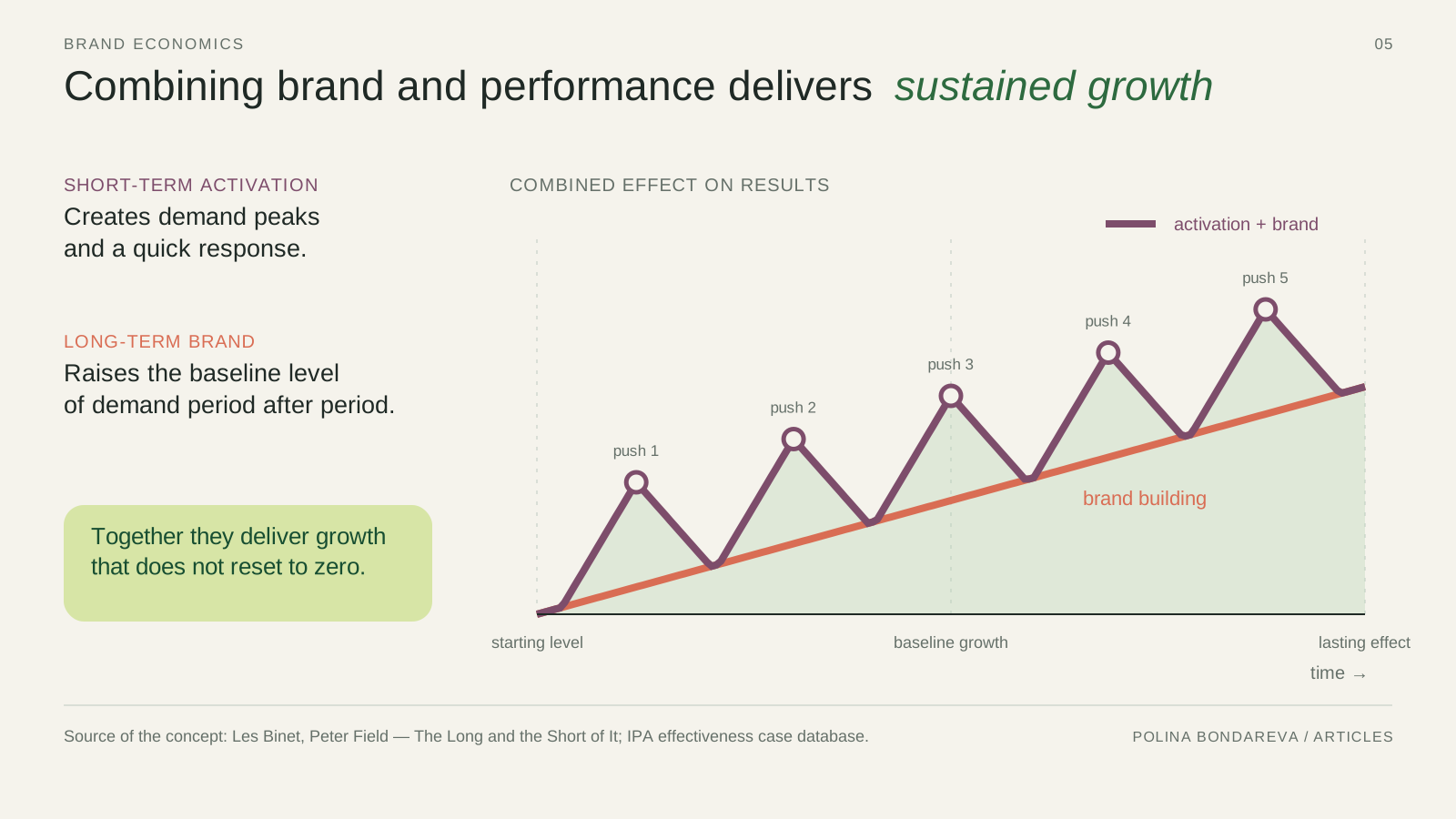
For a personal brand, the 60/40 principle should not be applied literally either. What matters here is separating the functions of the tools. PR, talks, original content and partnerships build awareness of a person in advance, reinforce their professional role and give grounds for trust. Search, lead generation and targeted promotion help turn interest that has arisen into an inquiry, a meeting or an offer of cooperation.
Without promotion, a brand may remain recognition that does not lead to action. Without a brand, promotion mostly produces short-term spikes and requires paying for the audience’s attention again and again. A lasting system appears when both rely on one position: the brand answers why a person should be remembered and chosen, and promotion creates a specific reason and a clear way to get in touch with them.
How to measure a personal brand: look at the quality of choice, not reach
Follower counts, views and reach can be useful operational signals: they show whether content is spreading and attracting attention. But on their own these numbers say nothing about how much a reputation is worth. A personal brand starts working when not only a person’s visibility changes, but also how they are seen: in what professional role they are perceived, in which situations people think of them and what opportunities they are offered.
That is why, before active communication begins, it is important to record the starting point: what the person is associated with now, which tasks they are recommended for, what inquiries they receive and how the market explains their value. Then choose three to five indicators directly linked to the professional or business goal.
These might include:
- association with the desired professional role and priority topics;
- making the initial shortlist for a project, position or partnership;
- willingness to consider the person for an appointment, a talk, an expert comment or a certain class of tasks;
- the number and quality of relevant incoming inquiries;
- the precision of recommendations — how clearly others can explain why this particular person is the one to turn to;
- share of voice in priority topics and the quality of media mentions;
- conversion of an incoming inquiry into a meeting, an offer or a project;
- the number of repeat invitations and recommendations;
- changes in the terms of cooperation and the economic value of projects;
- the share of opportunities that match the desired role rather than pulling the person back into their old positioning.
Not all indicators need to be assessed equally often. Reach, inquiries and conversion can be tracked monthly. Changes in professional associations, the quality of recommendations and the structure of incoming offers — quarterly. The brand’s effect on project value, the level of partnerships and freedom of choice is better assessed over a longer horizon.
At the same time, a personal brand should not be credited with every new contract. The purpose of measurement is to see a stable link between how a person is perceived, in which situations people think of them and what opportunities arise as a result. If only media visibility changes, while the role, level of trust and quality of offers stay the same, the brand is still working as communication and has not yet become a reputational asset.
CONCLUSION
The main effect of a personal brand is that the market starts assessing your scale more accurately
A personal brand does not create professional value from scratch and does not replace expertise, a strong product or proven results. It narrows the gap between what a person is really worth and how the market assesses them.
While this gap remains, others have to rely on the most accessible signs: job title, how well-known the company is, follower count, credentials or price. That is why even a strong professional can stay underrated — not because they lack experience, but because it is hard for the market to quickly understand what exactly their strength is, which tasks they are needed for and why they should be chosen.
A well-assembled personal brand solves this recognition problem. Publications, talks, projects, the website, recommendations and partnerships stop being scattered activities and start working as a single system of signals. Each new appearance reinforces the professional role, adds evidence, strengthens the right associations and lowers the risk of choice for the other side.
As a result, what changes is not only the number of opportunities, but above all their quality. The person is invited not “as an expert in general”, but to solve a certain class of tasks. They are more often included in the initial shortlist, their level of expertise is understood faster, they are compared on price alone less often, they are trusted with more complex projects and recommended to others more precisely.
At the same time, the brand starts to work as a filter: it increases the share of opportunities that match the desired role and reduces the number of offers that pull the person back into their old positioning. Gradually, the right to choose emerges — projects, topics, partners, audiences and terms of cooperation.
The market never sees a person in full — it assesses the system of signals available to it. The task of a personal brand is to make this system so clear and evidence-based that the market’s assessment matches the person’s real scale, and their reputation keeps accumulating value even before a personal meeting.PRIMARY SOURCES
Sources and notes
- WPP / Kantar Millward Brown. BrandZ Top 100 Most Valuable Global Brands 2017. Performance of the BrandZ portfolio from April 2006 to April 2017: 124.9%; S&P 500: 82.1%; MSCI World: 34.9%. Open source ↗
- Jonathan Knowles / Type 2 Consulting. How much of enterprise value is brand? An analysis of the share of brand value in market value and its spread across industries. Open source ↗
- Millward Brown. The Meaningfully Different Framework, 2013. Brand Power compared with purchase volume and the index of price paid, based on data from 1,600 consumers, 65 brands and four categories.
- Kantar. Brand Guidance: Guidance to shape your brand future. Current validation of Demand Power, Pricing Power and Future Power. Open source ↗
- Unilever. Deutsche Bank Global Consumer Conference 2019. Data on 28 Sustainable Living Brands that grew 69% faster than the rest of the portfolio in 2018. Open source ↗
- Cone Communications. 2017 Cone Communications CSR Study. A survey of US consumers: 87% and 76%. Open source ↗
- Havas Group. Meaningful Brands 2021. A global survey of 395,000 people: expectations of action, trust in promises and the interchangeability of brands. Open source ↗
- The Wall Street Journal. Airbnb Says Its Focus on Brand Marketing Instead of Search Is Working, 3 November 2022. Open source ↗
- IPA / Les Binet, Peter Field. The Long and the Short of It. Research on long-term brand building and short-term activation; the 60/40 benchmark and the limits of its use. Open source ↗